Creatio agentic marketing cookbook
Marketing teams operate in an environment where expectations continue to rise. Marketers must create personalized campaigns faster, analyze engagement signals across multiple channels, deliver qualified leads to sales, and continuously optimize campaign performance — often with limited resources and growing workloads. Traditional marketing automation tools help execute campaigns but lack the ability to interpret engagement context, refine targeting intelligently, or support the full end-to-end marketing lifecycle.
This article covers Creatio's agentic marketing approach that addresses this gap.
Modern marketing operations are shifting toward a collaborative model that blends human creativity with AI-driven agents.
- Humans contribute strategy, creativity, and storytelling.
- AI Agents handle analysis, content drafting, segmentation, and workflow coordination.
This partnership enables marketing teams to scale personalized engagement while reducing manual effort across campaigns.
Purpose
This document provides a strategic, non-technical overview of how Creatio.ai supports agent-driven marketing processes. It outlines:
- key scenarios where the agentic marketing approach adds value
- stages of the marketing lifecycle where each scenario has the greatest impact
- roles and teams that benefit from deploying each agent
- specific behaviors and tasks the agent performs
- underlying capabilities that power the agent
This Cookbook is not a technical configuration guide. Instead, it explains how agentic scenarios function, how they complement CRM processes, and how organizations can adopt them to strengthen marketing execution.
Learn more about Creatio.ai configuration and customization in separate guide: Creatio.ai.
This Cookbook is intended for marketing operations personnel, demand generation leaders, RevOps teams, business analysts, and system integrators involved in designing, configuring, or maintaining marketing-related processes in Creatio.
Use this document to:
- Identify current marketing challenges and match them to relevant agentic scenarios
- Understand how agents enhance existing marketing workflows
- Prioritize where AI can deliver the highest impact
- Explore how Creatio's agentic capabilities evolve as marketing needs grow
Agentic marketing overview
In Creatio, an AI Agent serves as a role-specific virtual teammate equipped with the following:
- generative AI abilities
- predictive insights
- CRM and campaign data retrieval
- engagement signal analysis and summarization
- automated marketing recommendations
- guided next steps
Instead of manually reviewing campaign metrics, drafting emails, or analyzing lead behavior, marketers can delegate these tasks to agents that execute them instantly and consistently.
The Creatio agentic marketing approach is built around following agentic scenarios, each supporting a distinct phase of the marketing cycle:
- audience segmentation and targeting
- email creation and editing
- campaign setup and management
- campaign optimization and feedback
- conversion insights and lead qualification
- lead routing and sales alignment
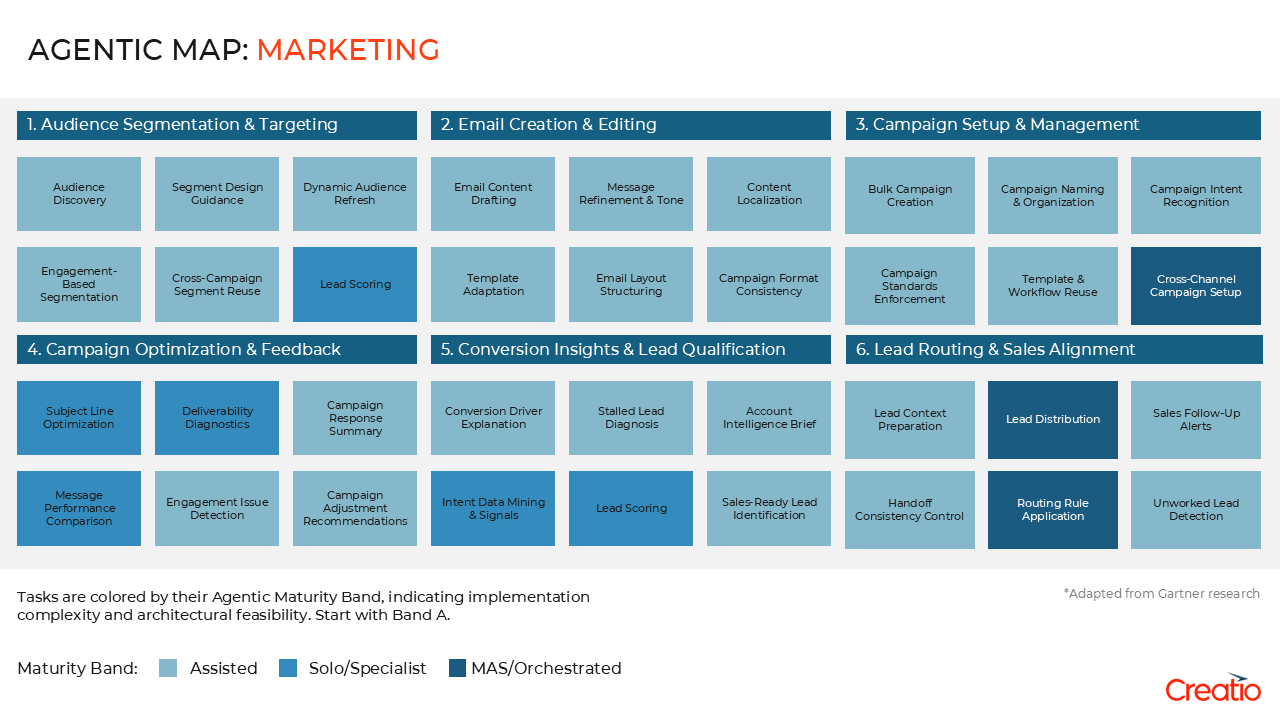
Together, they form a connected multi-agent marketing ecosystem that helps organizations reduce manual campaign management work, improve targeting and personalization, accelerate campaign execution, increase conversion rates, and strengthen marketing-sales alignment.
Composable AI architecture
Creatio's composable AI architecture makes it possible to:
- assemble agentic workflows using modular building blocks
- tune behavior
- connect additional Sub-agents or third-party data sources
- trigger agents through CRM events or user actions
- extend Creatio functionality using no-code tools
This flexibility enables organizations to adopt agentic scenarios gradually, deploy them as productivity accelerators, or build toward a fully AI-supported marketing model.
AI Agents can be deployed as out-of-the-box accelerators or extended with new Sub-agents such as predictive scoring, intelligent summarization, audience segmentation, or campaign analysis.
Key agentic marketing scenarios
Scenario | Primary users | Core value |
|---|---|---|
Marketing Operations, Demand Generation, Campaign Managers | AI-driven audience identification and segmentation using CRM data and engagement signals. | |
Content Marketers, Campaign Managers, Demand Generation | Accelerated email drafting with tone adjustment, localization, and brand consistency. | |
Marketing Operations, Campaign Managers | AI-generated campaign messaging and consistent content structure across campaigns. | |
Marketing Managers, Demand Generation, Marketing Operations | Automated performance summarization and AI-driven improvement recommendations. | |
Demand Generation, Marketing Operations, RevOps | AI-supported identification of high-intent prospects and conversion drivers. | |
Marketing Operations, RevOps, Sales Operations | Automated lead summarization and context-rich handoff to sales teams. |
Below are the core agentic scenarios that collectively support the full marketing lifecycle.
Each scenario includes:
- purpose
- agent behaviors
- AI Agents used (where applicable)
- Sub-agents used
- considered configuration steps
- primary users
- manual effort eliminated
- manual workflow → agent-assisted workflow comparisons
Audience segmentation and targeting agent
Purpose
Marketing teams often spend significant time identifying and refining audience segments across multiple campaigns. This slows down campaign launches, limits personalization, and increases the risk of targeting the wrong contacts.
The Audience segmentation and targeting agent automates this work by analyzing CRM data and engagement signals, identifying relevant segments, and surfacing high-intent prospects.
Agent behaviors
- identifies relevant audience segments using CRM and engagement data
- analyzes behavioral patterns and engagement signals
- suggests segmentation strategies aligned with campaign goals
- filters audiences based on intent and activity indicators
- highlights high-value prospects for prioritized outreach
AI Agents used
- Segmentation Agent
- Filter Agent
Sub-agents used
- "Provide contact conversion insights"
- "Provide account conversion insights"
- "Search data"
Configuration considerations
- engagement-based segmentation models to reflect behavioral patterns
- reusable segment templates for recurring campaign types
- additional intent data sources to enrich targeting signals
- scoring models to support dynamic audience prioritization
- automated re-segmentation triggers when engagement patterns shift
Primary users
Marketing Operations, Demand Generation, Campaign Managers
Eliminated effort
Users no longer need to:
- manually analyze engagement reports to build segments
- repeatedly recreate segmentation logic for each campaign
- identify high-intent audiences through manual review
Manual workflow → Agent-assisted workflow
Before (human):
- analyzes engagement reports manually
- builds segmentation logic in spreadsheets or static rules
- identifies high-intent audiences through manual review
After (AI Agent):
- analyzes engagement signals automatically
- produces segmentation recommendations instantly
- enables dynamic segment creation at campaign speed
Email creation and editing agent
Purpose
Campaign email creation often requires multiple drafting iterations, manual tone adjustments, and significant editing effort. These delays slow campaign timelines and introduce inconsistencies in messaging.
The Email creation and editing agent focuses on email text and messaging — accelerating copy drafting, tone adjustments, and localization while keeping communication consistent across segments and campaign types.
Agent behaviors
- generates email drafts based on campaign goals and audience context
- refines messaging tone to match brand or segment-specific guidelines
- adapts content for different audience segments within the same campaign
- localizes messaging for different languages or regions
- corrects grammar and ensures message clarity
Sub-agents used
- "Formal text rewrite"
- "Friendly text rewrite"
- "Rephrase text"
- "Extend text"
- "Translate text"
- "Generate content" (custom)
- "Correct grammar" (custom)
Configuration considerations
- brand tone guidelines to ensure consistent voice across generated content
- reusable email generation prompts for recurring campaign types
- campaign template libraries for faster content assembly
- approval workflows for reviewing AI-generated email drafts
- multi-language configurations for localized campaign execution
Primary users
Content Marketers, Campaign Managers, Demand Generation
Eliminated effort
Users no longer need to:
- draft campaign emails from scratch for each audience segment
- manually adjust messaging tone and style across versions
- rewrite content for localization or regional adaptation
Manual workflow → Agent-assisted workflow
Before (human):
- drafts and revises emails manually for each segment
- personalizes messaging through additional manual edits
- rewrites content separately for each language or region
After (AI Agent):
- generates draft emails instantly based on campaign context
- adjusts tone and messaging automatically per segment
- produces localized versions without additional manual effort
Campaign setup and management agent
Purpose
Campaign configuration often requires multiple manual steps, including defining campaign structure, preparing messaging content, and ensuring consistency across channels. This increases setup time and the risk of inconsistencies across campaigns.
The Campaign setup and management agent accelerates campaign preparation by generating messaging, recommending structures, and organizing content for consistent execution.
Agent behaviors
- generates campaign messaging aligned with campaign goals and audience context
- recommends campaign structures based on objectives and historical patterns
- organizes campaign content to ensure cross-channel consistency
- ensures messaging alignment across campaign stages
- summarizes campaign content for review and approval
Sub-agents used
- "Formal text rewrite"
- "Friendly text rewrite"
- "Rephrase text"
- "Extend text"
- "Summarize text" (custom)
- "Generate content" (custom)
Configuration considerations
- campaign templates and reusable workflow structures for recurring campaign types
- campaign naming and taxonomy conventions for consistent organization
- cross-channel campaign orchestration logic
- content summarization settings for campaign review workflows
- approval workflows to validate AI-generated campaign content before launch
Primary users
Marketing Operations, Campaign Managers
Eliminated effort
Users no longer need to:
- manually draft campaign messaging from scratch
- repeatedly build content structures for each new campaign
- verify cross-channel message consistency manually
Manual workflow → Agent-assisted workflow
Before (human):
- configures campaigns manually step by step
- drafts campaign messaging without AI assistance
- checks content consistency manually across channels
After (AI Agent):
- generates campaign messaging and structure automatically
- ensures consistent content across all campaign stages
- accelerates campaign launch with ready-to-review drafts
Campaign optimization and feedback agent
Purpose
Campaign performance analysis requires continuous monitoring of engagement metrics across channels. Manual review is time-consuming and often leads to delayed responses to underperforming campaigns.
The Campaign optimization and feedback agent consolidates performance signals, identifies patterns, and generates AI-supported improvement recommendations.
Agent behaviors
- summarizes engagement metrics and campaign performance indicators
- identifies performance trends and highlights engagement anomalies
- detects underperforming campaign elements or audience segments
- recommends adjustments to content, targeting, or scheduling
- generates campaign diagnostics for review by marketing managers
AI Agents used
Analytics Agent
Sub-agents used
- "Summarize text" (custom)
- "Generate content" (custom)
- "Search data"
Configuration considerations
- campaign diagnostics dashboards connected to performance data
- automated campaign performance alerts for key metric thresholds
- deliverability monitoring tool integrations
- rules that define what counts as underperformance to guide optimization recommendations
- scheduled performance review workflows for ongoing campaigns
Primary users
Marketing Managers, Demand Generation, Marketing Operations
Eliminated effort
Users no longer need to:
- manually review campaign dashboards to identify issues
- search for engagement trends across multiple reports
- compile performance summaries for marketing reviews
Manual workflow → Agent-assisted workflow
Before (human):
- reviews campaign dashboards manually
- identifies improvement opportunities through manual data analysis
- compiles performance summaries for stakeholder reviews
After (AI Agent):
- summarizes campaign performance automatically
- provides optimization recommendations instantly
- delivers ready-to-use diagnostics for campaign decision-making
Conversion insights and lead qualification agent
Purpose
Marketing teams must identify which leads show genuine buying intent before passing them to sales. Manual qualification processes are slow, inconsistent, and often miss signals that indicate readiness to convert.
The Conversion insights and lead qualification agent automates this process by analyzing engagement signals, identifying conversion drivers, and surfacing high-value prospects for prioritized follow-up.
Agent behaviors
- analyzes engagement signals to identify high-intent prospects
- identifies conversion drivers based on behavioral patterns
- detects stalled or low-activity leads that require re-engagement
- summarizes lead activity to support qualification decisions
- highlights qualification indicators aligned with lead readiness thresholds
Sub-agents used
- "Provide contact conversion insights"
- "Provide account conversion insights"
- "Search data"
- "Summarize text" (custom)
Configuration considerations
- predictive lead scoring models to prioritize high-intent contacts
- intent data source integrations to enrich engagement signals
- lead readiness thresholds that trigger qualification workflows
- customizable qualification logic aligned with campaign goals
- re-engagement workflows triggered by stalled lead detection
Primary users
Demand Generation, Marketing Operations, RevOps
Eliminated effort
Users no longer need to:
- manually analyze lead engagement patterns across campaigns
- investigate stalled leads through individual record review
- compile qualification summaries before passing leads to sales
Manual workflow → Agent-assisted workflow
Before (human):
- analyzes lead activity manually across reports and CRM records
- identifies conversion drivers through manual pattern analysis
- qualifies leads based on personal judgment and limited data
After (AI Agent):
- highlights high-intent leads automatically based on engagement signals
- generates conversion insights instantly
- delivers structured qualification data to support handoff decisions
Lead routing and sales alignment agent
Purpose
Marketing teams must ensure that qualified leads reach the appropriate sales teams quickly and with sufficient context. Manual handoff processes slow lead progression, reduce conversion rates, and leave sales teams without the context needed for effective outreach.
The Lead routing and sales alignment agent streamlines lead distribution by summarizing lead context, identifying sales-ready contacts, and supporting routing decisions.
Agent behaviors
- summarizes lead engagement history and qualification context for sales teams
- identifies sales-ready leads based on scoring and behavioral indicators
- generates structured lead briefings to accelerate sales outreach
- supports routing decisions by matching leads to the appropriate teams or reps
- flags high-priority leads that require immediate follow-up
Sub-agents used
- "Search data"
- "Provide contact conversion insights"
- "Provide account conversion insights"
- "Summarize text" (custom)
Configuration considerations
- automated lead distribution rules connected to scoring or qualification thresholds
- sales readiness criteria definitions that trigger routing workflows
- CRM assignment logic integrations for automated lead routing
- lead briefing templates for generating consistent sales context summaries
- priority escalation rules for high-intent or time-sensitive leads
Primary users
Marketing Operations, RevOps, Sales Operations
Eliminated effort
Users no longer need to:
- manually review lead engagement history before handoff
- summarize lead context for sales teams by hand
- identify sales-ready leads through individual record inspection
Manual workflow → Agent-assisted workflow
Before (human):
- reviews lead records manually to assess sales readiness
- summarizes lead context in handoff notes or emails
- routes leads to sales teams based on personal judgment
After (AI Agent):
- generates lead summaries and briefings automatically
- identifies sales-ready leads based on scoring and engagement signals
- routes leads to the correct teams with full context attached
Steps to adopt agentic marketing
Creatio's agentic marketing approach transforms how marketing teams operate by bringing AI-driven intelligence, context, and automation into every stage of the marketing lifecycle.
Each agent—from audience segmentation to lead routing—helps teams reduce manual effort, automate repeatable workflows, ensure consistent campaign execution, and deliver more informed interactions with prospects and customers.
The outcome is a connected, composable, and scalable multi-agent ecosystem that supports both individual marketer performance and organizational marketing effectiveness.
Below is a recommended phased approach for deploying agentic scenarios in Creatio.
1. Identify the highest-impact pain points
Start by mapping organizational challenges to the agentic scenarios. This clarifies where automation can remove the most manual work and deliver immediate value.
Examples:
- Slow and inconsistent campaign email creation → Email creation and editing agent
- Manual and fragmented audience targeting → Audience segmentation and targeting agent
- Poor lead conversion and inconsistent qualification → Conversion insights and lead qualification agent
- Delayed or context-poor lead handoffs to sales → Lead routing and sales alignment agent
This helps prioritize high-ROI areas for initial deployment.
2. Identify 1–2 highest-priority agents
We recommend deploying agentic scenarios gradually. Start by selecting 1-2 scenarios that address your most immediate operational challenges and deliver visible impact quickly.
Anchor candidates:
- Email creation and editing agent — immediate productivity gain for campaign teams
- Audience segmentation and targeting agent — improves targeting quality across all campaigns
- Conversion insights and lead qualification agent — high value for Demand Generation and RevOps
These scenarios deliver fast wins and help teams adapt to agent-assisted processes.
3. Configure predictive Sub-agents and workflows
Each agent uses a combination of:
- content generation and rewriting skills
- engagement signal analysis
- predictive scoring and segmentation
- next-best-action recommendations
- summarization and insight generation
- CRM data retrieval connected to campaigns, contacts, and accounts
Tune these elements to align with your organization's campaign data, audience definitions, and marketing workflows.
4. Integrate with existing CRM processes
Agentic behaviors have to complement—not replace—your established marketing processes. Ensure each agent's output flows naturally into the operational workflows your teams already use.
Examples:
- Segments produced by the Audience segmentation and targeting agent feed campaign launch workflows.
- Drafts produced by the Email creation and editing agent integrate with campaign content review processes.
- Insights provided by the Campaign optimization and feedback agent connect to campaign management dashboards.
- Briefings provided by the Lead routing and sales alignment agent feed marketing-to-sales handoff workflows.
Ensuring alignment with existing processes improves adoption.
5. Expand using additional skills and data sources
Creatio's composable architecture allows teams to extend agents with:
- third-party enrichment and intent data sources
- industry-specific segmentation Sub-agents
- specialized content generation skills
- predictive scoring models for lead and account qualification
- custom workflows tailored to your campaign methodology
This enables iterative improvement without rewrites or complex development.
See also
Resources
Creatio.ai Foundational & Introductory